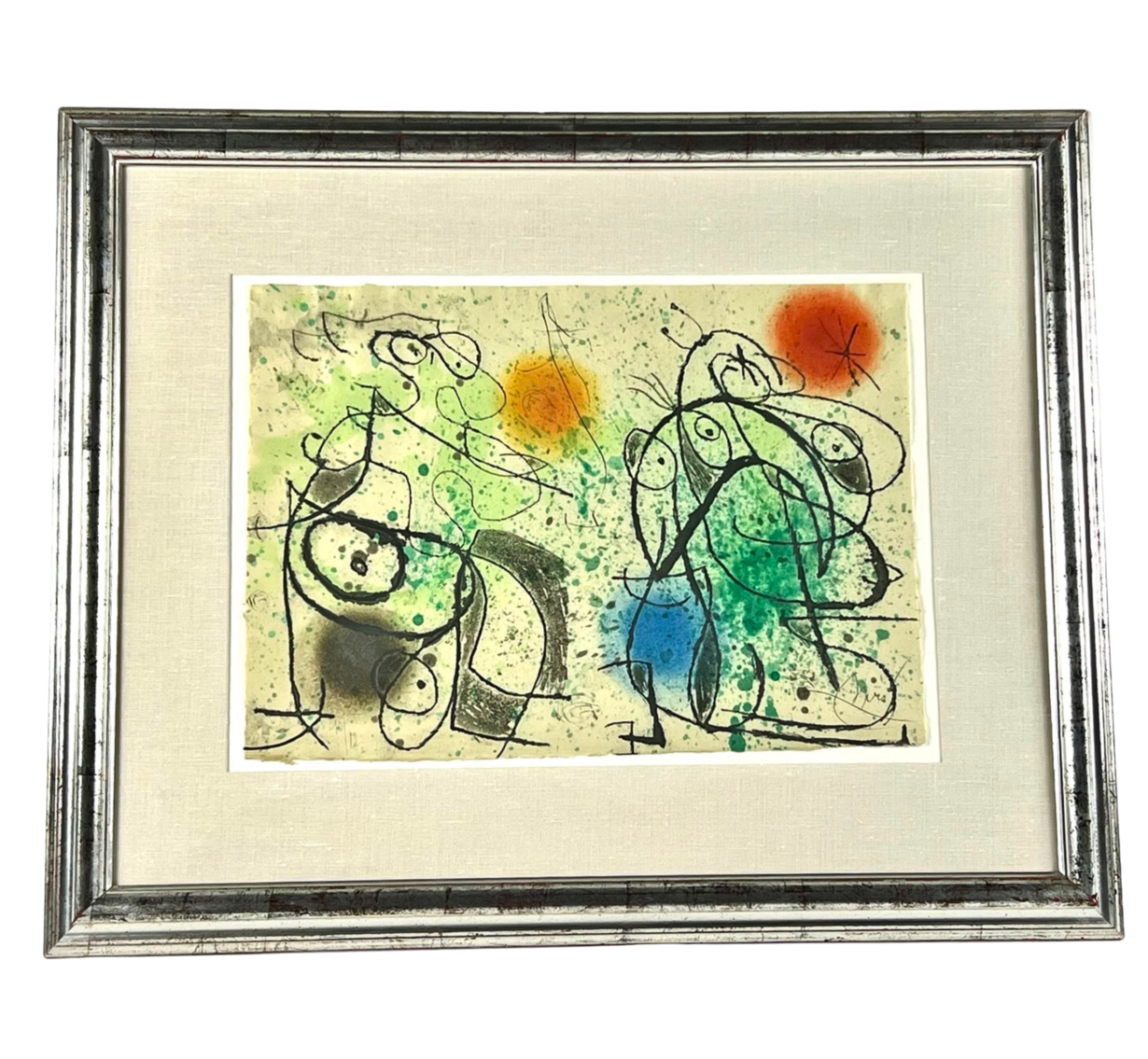
#1 • Joan Miró: Original Signed Framed Etching w/ Aquatint and Drypoint LE #10/12
Part of Fine Art and Jewelry Extravaganza: Bid on Masterpieces by Vasarely, Erte, Picasso, Max, and More! (timed auction by Lux Auctions)
High bid $3,550.00
Status: No sale
Category: Art
This is a professionally framed original limited edition etching with aquatint and drypoint by famed Spanish artist Joan Miró (1893-1983). This image was featured as a double page plate I (folios 4 verso and 5) in Le Courtesan grotespque, a handmade book with text by Russian bookmaker Iliazd (Ilia Zdanevich) in 1974. Our piece is, however, an original etching with aquatint, not a print. Signed by the artist in pencil in the lower right, with edition 10/12 written on the lower left, this is a rare original work with a very short run. Beautifully framed in a faux distressed silver wood frame with a wrapped oatmeal-tone single mat, the art is "floated" within the frame, leaving all imperfect edges exposed. Felt bumper pads and a wire to hang by in back. Very good condition - the art lies flat, the frame does not have chips or cracks, the mat is very clean. A few 1/2" tears in the backing paper. Dimensions: Frame - 36" wide x 29" tall, Floated Art - 23" wide x 16" long. Please see our photos for additional details. About the artist: Joan Miró Ferra was born April 20, 1893, in Barcelona (Catalonia) Spain. At the age of 14, he went to business school in Barcelona and also attended La Lonja’s Escuela Superior de Artes Industriales y Bellas Artes in the same city. Upon completing three years of art studies, he took a position as a clerk. After suffering a nervous breakdown, he abandoned business and resumed his art studies, attending Francesc Galí’s Escola d’Art in Barcelona from 1912 to 1915. In 1920 Miró made his first trip to Paris, where he met Pablo Picasso. From this time, Miró divided his time between Paris and Montroig, Spain. In Paris he associated with the poets Max Jacob, Pierre Reverdy, and Tristan Tzara and participated in Dada activities. Miró became known as a Surrealist and worked in several mediums throughout his lifetime - painting, papers collés, lithography, etchings, and sculpture. His characteristic biomorphic form was influential in 20th century abstraction, with Alexander Calder and others. Miro had a unique place between Surrealism and Abstract Expressionism, influencing the New York School of painters in the 1940's and '50's. He received many awards including a Grand Prize for Graphic Work at the Venice Biennale in 1954, a Guggenheim Award for murals in 1958, and a Gold Medal for Fine Arts from King Juan Carlos (Spain) in 1980. His work is seen in major museums around the world including the Guggenheim and Museum of Modern Art in NYC. Miró died in Mallorca, Spain in 1983.