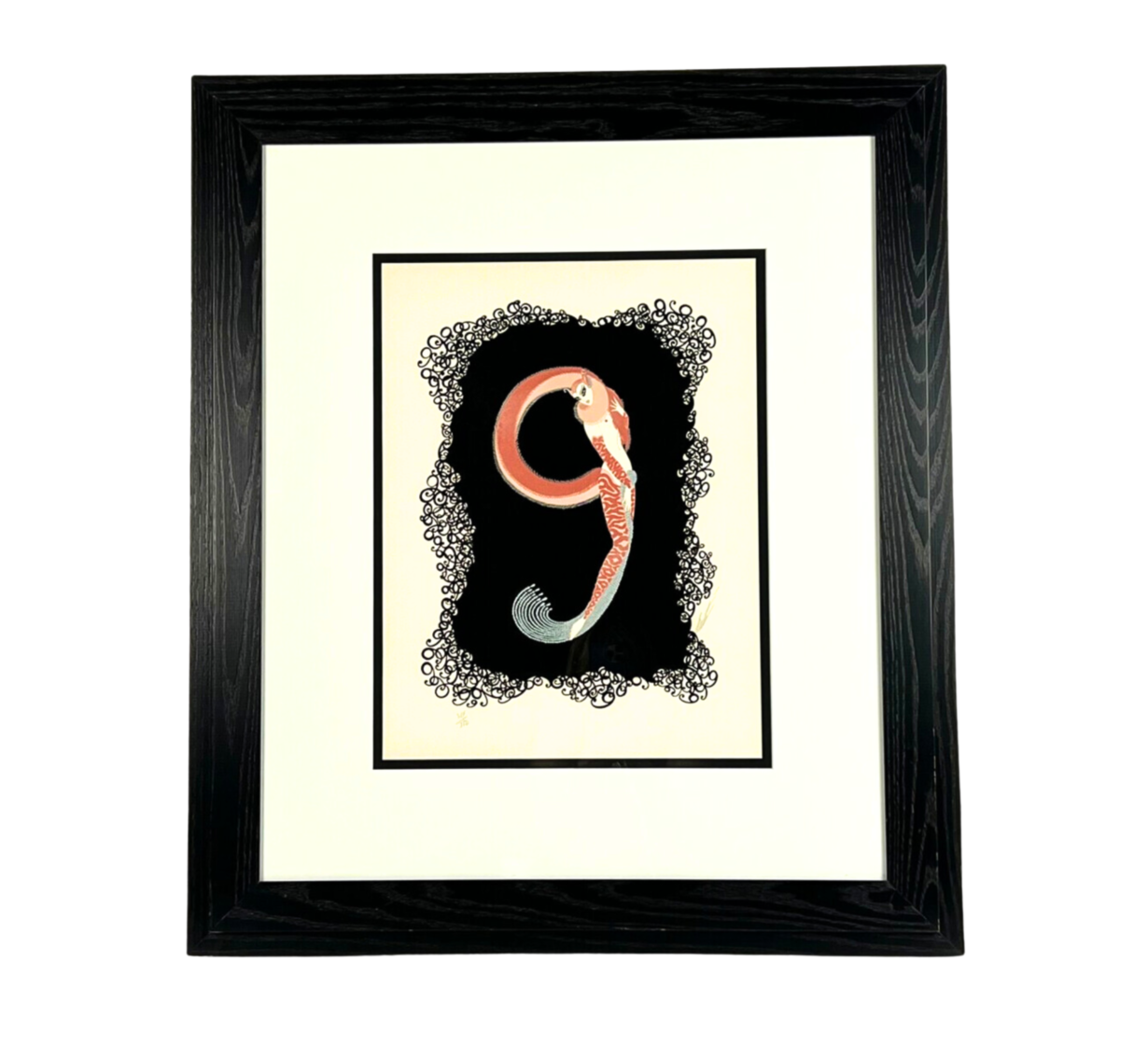
#19 • Erté: "Number Nine" Framed Signed Limited Edition Lithograph #214/350
Part of Fine Art and Jewelry Extravaganza: Bid on Masterpieces by Vasarely, Erte, Picasso, Max, and More! (timed auction by Lux Auctions)
High bid $1,075.00
Status: No sale
Category: Art
This signed, limited edition lithograph by Erté (Romain de Tirtoff) (1892-1990) is part of his Numerals series from 1968. A topless female dances, perhaps costumed as a leopard, grasping her long tail as it curls around her. She holds a long strand of pearls. Geometric patterns in a mauve color have a raised "flocked" texture and part of her grey torso consists of raised dots, adding a distinct element of dimensionality. The figure floats on a black field, with stylized "9's" forming an ornate border. Hand-signed in pencil on the right border and numbered 214/350. Framed in a black-stained wood frame with a double black and cream 4" mat. There are felt pads, "D" rings and a wire to hang by in back. Very Good condition. Please see our photos for additional details. Dimensions: Frame size - 30" w x 35" tall, Art opening - 15.5" w x 20.5" tall. About the artist: Born in St. Petersburg, Russia, Romain de Tirtoff (or “Erté” – a nickname based on the French pronunciation of his initials) was destined for a military career. However, he defied expectations and proved that he was to become a fabulous fashion illustrator, moving to Paris in 1912. He is notorious for his elaborate costumes and exotic designs for the French theater, especially at the Folies-Bergère in Paris. In 1915, he landed a contract with Harper's Bazaar, illustrating and designing covers. Throughout his lifetime, the artist designed over 240 covers for that magazine. Erté also spent a brief period of his life in Hollywood in 1925, working with MGM at the invitation of Louis B. Mayer. Erté is often referenced as one of the founders of Art Deco, the style that came into vogue internationally in the 1920s. Erté defined it as the fusion of the curvilinear designs of Art Nouveau of the 19th Century with the Cubist, Constructivist, and geometrical designs of modernity. His imagination was limitless and Erté designed costumes, stage sets, jewelry, objet d’art, sculpture, and ceramics.