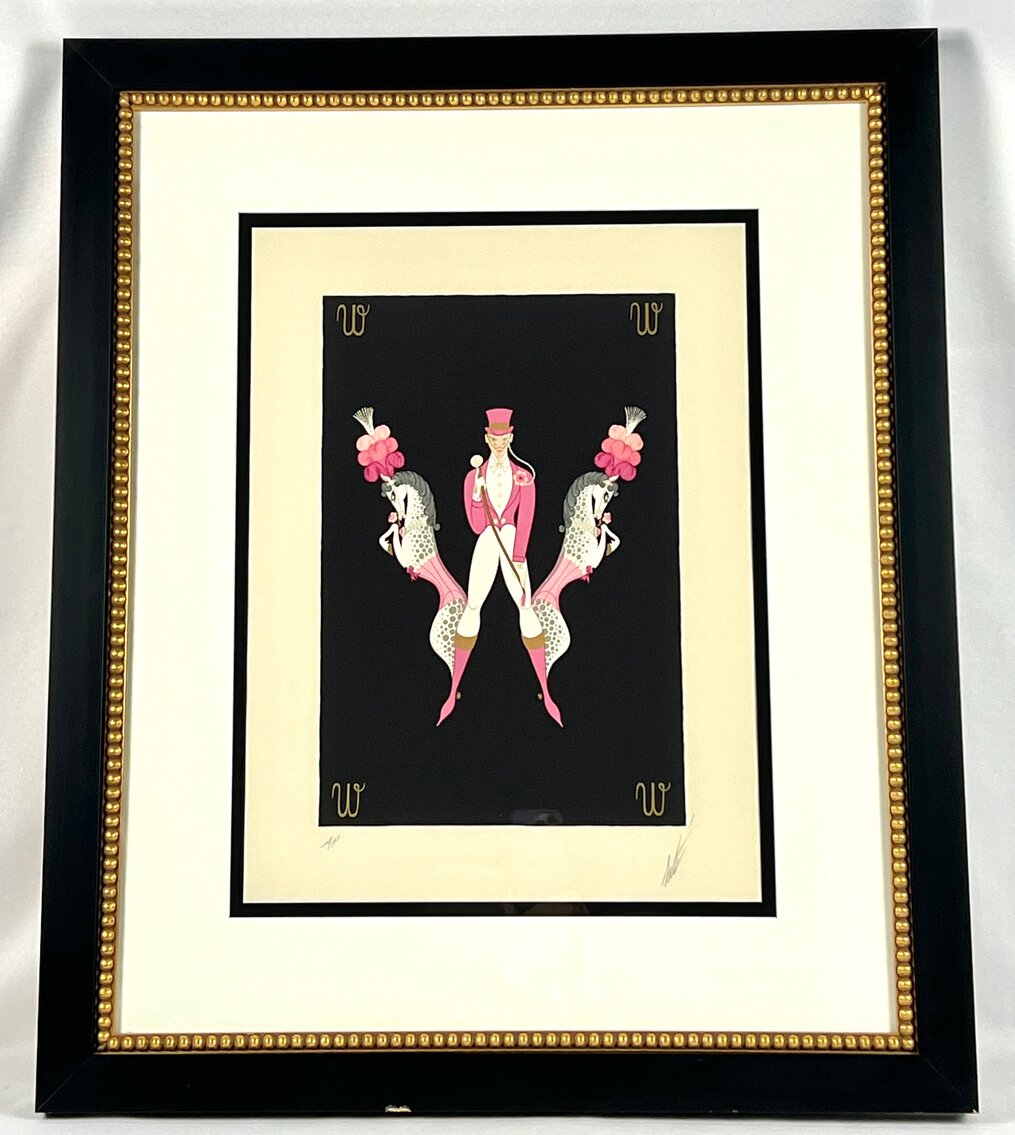
#20 • Erté: "Letter W" Framed Signed Lithograph - Artist's Proof
Part of Fine Art and Jewelry Extravaganza: Bid on Masterpieces by Vasarely, Erte, Picasso, Max, and More! (timed auction by Lux Auctions)
High bid $1,075.00
Status: No sale
Category: Art
This is a signed lithograph by Erté (Romain de Tirtoff) (1892-1990) titled "Letter W" from his suite "Letters of the Alphabet" 1976. Hand-signed in pencil and labeled "A/P" (Artist's Proof). A stylized gent with monocle and top hat stands between two dappled grey horses in corsets, forming the letter "W". Gold letter W's grace each corner. Framed in a substantial black wood frame with 1/2" beading on the inside edge. There are felt pads, "D" rings and a wire to hang by in back. The art is in very good condition and lies clean and flat within the frame. There is a 1/2" chip to the bottom edge of the frame and a tiny chip in the right lower corner. Please see our photos for additional details. Dimensions: Frame size - 26" w x 31.5" tall, Art Opening - 14.75" w x 19.75" tall. About the artist: Born in St. Petersburg, Russia, Romain de Tirtoff (or “Erté” – a nickname based on the French pronunciation of his initials) was destined for a military career. However, he defied expectations and proved that he was to become a fabulous fashion illustrator, moving to Paris in 1912. He is notorious for his elaborate costumes and exotic designs for the French theater, especially at the Folies-Bergère in Paris. In 1915, he landed a contract with Harper's Bazaar, illustrating and designing covers. Throughout his lifetime, the artist designed over 240 covers for that magazine. Erté also spent a brief period of his life in Hollywood in 1925, working with MGM at the invitation of Louis B. Mayer. Erté is often referenced as one of the founders of Art Deco, the style that came into vogue internationally in the 1920s. Erté defined it as the fusion of the curvilinear designs of Art Nouveau of the 19th Century with the Cubist, Constructivist, and geometrical designs of modernity. His imagination was limitless and Erté designed costumes, stage sets, jewelry, objet d’art, sculpture, and ceramics.