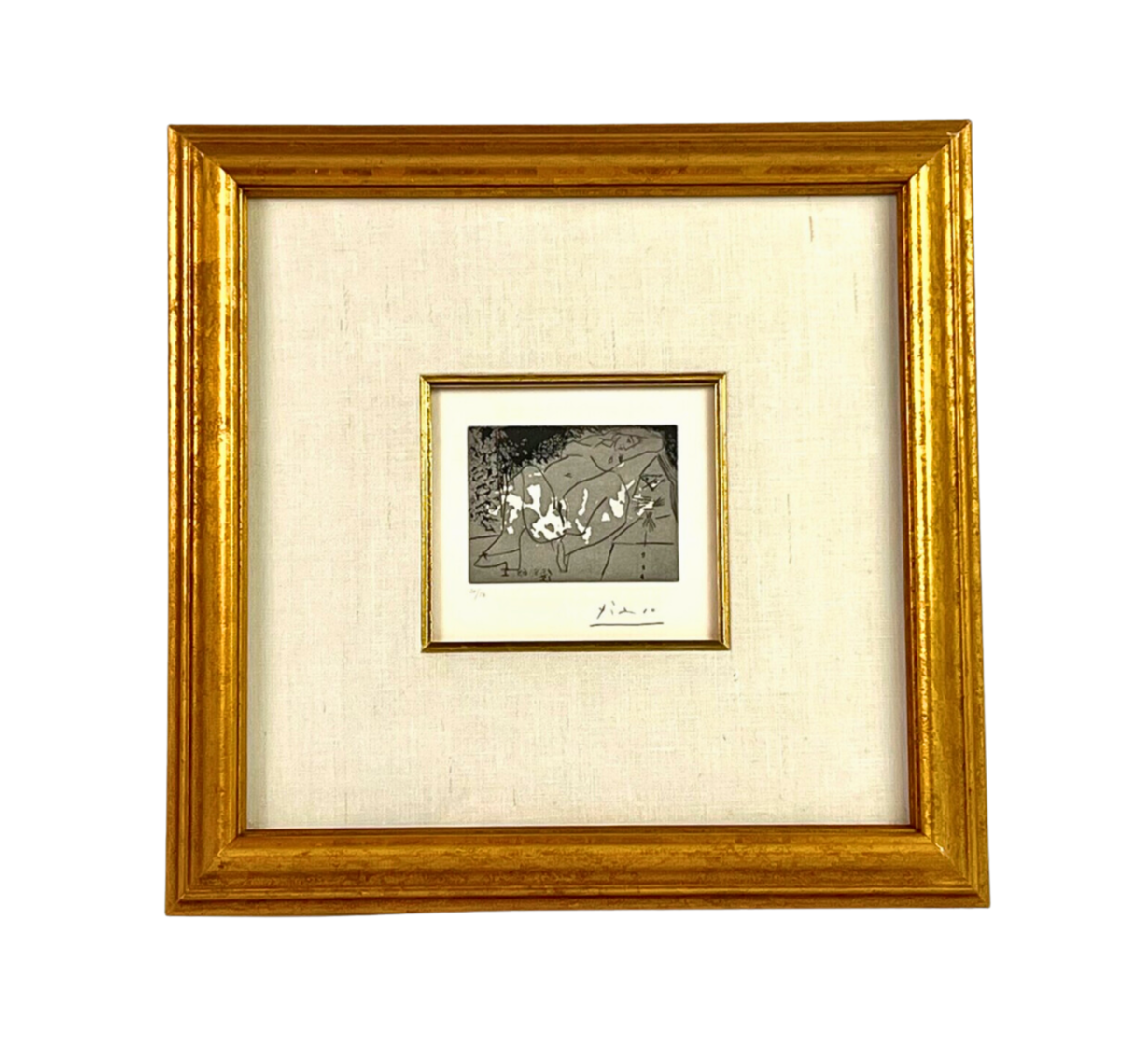
#16 • Pablo Picasso: Signed "347 Suite" 20/50- Reclining Nude Etching, Framed, Limited Edition
Part of Fine Art and Jewelry Extravaganza: Bid on Masterpieces by Vasarely, Erte, Picasso, Max, and More! (timed auction by Lux Auctions)
High bid $3,025.00
Status: No sale
Category: Art
A female nude reclines as a mustachioed man looks on. An etching with a mottled grey and black background. Some numerals are visible but reversed. Possibly a date of 8/13/68. Signed in pencil by the artist and numbered #20/50. Referenced in Georges Bloch Catalogue of Printed Work - 1752. The piece is centered in a 3.5" wide linen mat with a gold fillet, and framed in an elegant gilt wood frame with clean lines. There is a wire to hang by in the back. Very good condition - that art is crisp and lies flat behind the glass. The frame is solid and beautiful, with just very minimal wear on some corners. The brown paper on the back is torn in multiple places. This does not affect the art beneath. Please see our photos for additional details. Dimensions: 17-3/4" w x 17-1/4 tall - Art Opening - 6" w x 5/5" tall, Etching plate - 4.5" w x 3.5" tall. About the artist: Pablo Picasso (1881-1973) was a Spanish painter who is widely acknowledged to be the most important artist of the 20th century. He experimented with a wide range of styles and themes in his long career, most notably inspiring 'Cubism'. Pablo Ruiz was born in Malaga 1881, the son of an art teacher. He later adopted his mother's maiden name of Picasso. He grew up in Barcelona, showing artistic talent at an early age. In the early 1900s, he moved between France and Spain before finally settling in Paris in 1904. There he experimented with a number of styles and produced his own original ones, reflected in his 'Blue' and 'Rose' periods. In 1907 Picasso painted 'Les Demoiselles d'Avignon', a revolutionary work that introduced a major new style - 'Cubism'. Picasso's next major innovation, in 1912, was 'Collage', attaching pieces of cloth, newspaper or advertising to his paintings. Picasso then moved from style to style, experimenting with painting and sculpture and becoming involved with the Surrealist movement. In 1937, he produced 'Guernica', a painting inspired by the destruction of the town in northern Spain by German bombers during the Spanish Civil War. Picasso supported the Republican government fighting General Francisco Franco, and never returned to Spain after Franco's victory. Unlike many artists, Picasso remained in Paris during the German occupation. From 1946 until his death he lived mainly in the south of France. He continued to produce a huge variety of work including paintings, sculptures, etchings and ceramics. Picasso was involved with a number of women during his life who were often artistic muses as well as lovers. He had four children.